
Association Between International Editorial Staff and International Publications in Leading Biomedical Journals
Abstract
Gandolina Melhem,1 Chris A. Rees,2,3 Bruno F. Sunguya,4 Mohsin Ali,5 Anura Kurpad,6 Christopher P. Duggan7,8 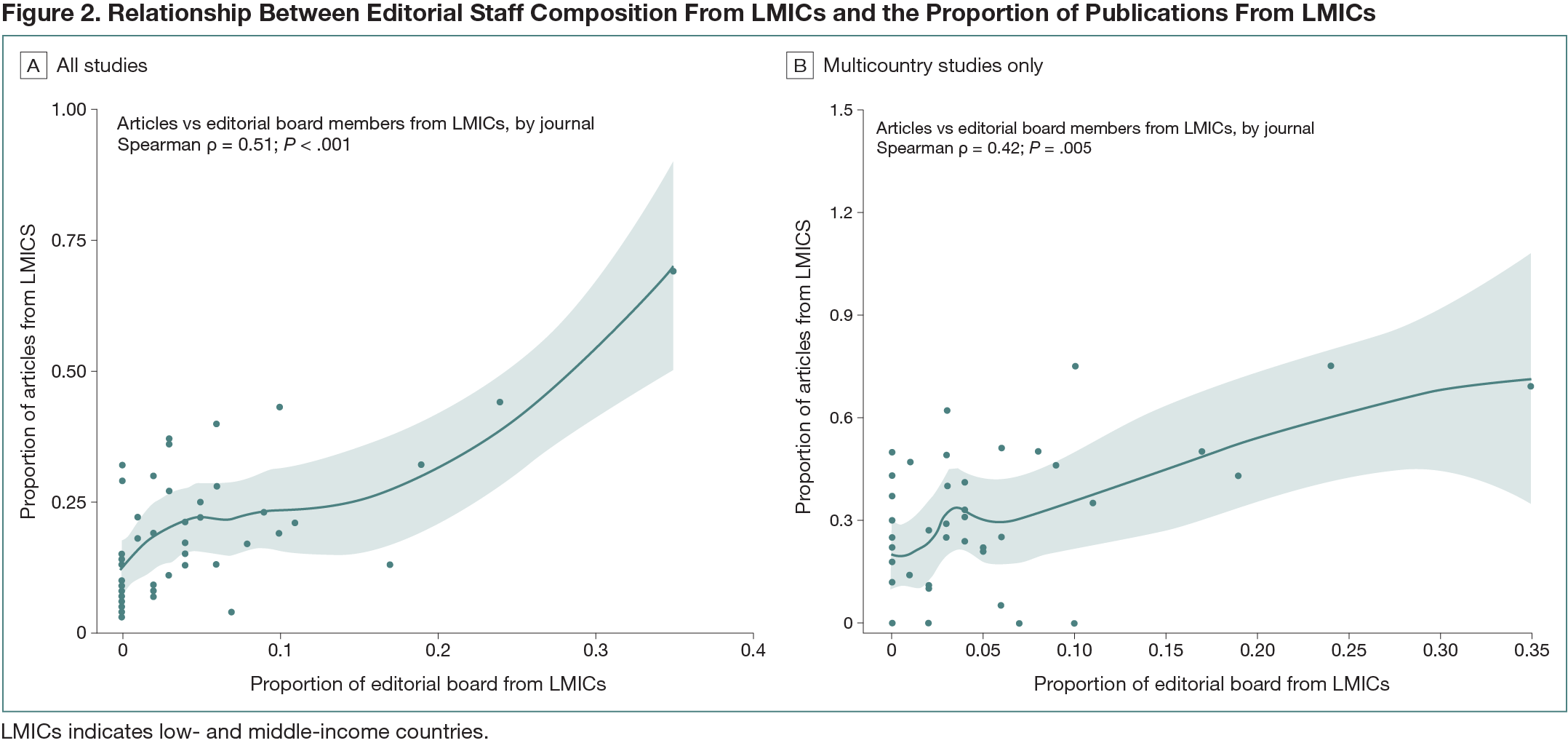
Objective
To examine the association of having editorial staff members affiliated with low- and middle-income countries with publications from low- and middle-income countries in leading biomedical journals. It was hypothesized that greater representation from low- and middle-income countries among editorial staff would be associated with more published articles from low- and middle-income countries.Design
A cross-sectional study was conducted of biomedical journals in 2020 in fields whose content covers the largest disease burden globally. To obtain editorial staff country affiliations, webpages of the 5 leading journals in each of the following fields were reviewed: general medicine, pediatrics, surgery, obstetrics and gynecology, cancer, cardiovascular diseases, infectious diseases, psychiatry, and nutrition. Original research articles in each journal were reviewed through MEDLINE. The study country of each original research article (ie, where the study was conducted) was determined by searching the article title, abstract, keyword, and medical subject heading using EndNote, and by 2 authors reviewing the full text of each article to assign a study country. Editorial staff country affiliations and study country location(s) were classified according to the World Bank income brackets and regions. Descriptive statistics were used to describe the proportion of editorial staff affiliated with each income bracket and region. Spearman ρ was used to assess the relation between the proportion of editorial staff affiliated with low- and middle-income countries and published articles reporting work conducted in these countries.Results
There were 3819 editorial staff in the 45 included journals: 3637 (95.2%) were affiliated with high-income countries, 140 (3.7%) with upper−middle income countries, 37 (1.0%) with lower−middle income countries, and 5 (0.1%) with low-income countries. Every editor in chief (n = 48; 100.0%) was affiliated with a high-income country. Of the 459 associate editors, 445 (96.9%) were affiliated with high-income countries, 10 (2.2%) with upper−middle income countries, 4 (0.9%) with lower−middle income countries, and 0 with low-income countries. Editorial staff were most commonly affiliated with North American (2120 [55.5%]) and European and Central Asian countries (1256 [32.9%]). Of the 10,096 original research articles included, 7857 (77.8%) reported research conducted in high-income countries, 1562 (15.5%) in upper−middle income countries, 507 (5.0%) in lower−middle income countries, and 170 (1.7%) in low-income countries. Greater editorial staff representation correlated moderately with more published articles reporting research conducted in low- and middle-income countries among all articles (Spearman ρ, 0.51; P < .001) and among articles reporting multicountry studies (Spearman ρ, 0.42; P = .005) (Figure 2).